We are so used to those luscious candies we justify eating at Christmas time—fudge, Godiva chocolates, cherry cordials, etc.—that we don’t consider how little chocolate was available during the Regency, and certainly not in cream-filled or even buttery forms. Mostly, chocolate was for drinking.
Here, however, are two recipes for candies that might have been made at Christmas time—confectionary and chocolate drops.
To Make Confectionary Drops
Dutch cocoa
Take double refined sugar, pound and sift it through a hair sieve, not too fine; then sift it through a silk sieve to take out all the fine dust which would destroy the beauty of the drop. Put the sugar into a clean pan, and moisten it with any favourite aromatic…Colour it with a small quantity of liquid carmine, or any other colour, ground fine. Take a small pan with a lip, fill it three parts with paste, place it on a small stove, the half hole being the size of the pan, and stir the sugar with a little ivory or bone handle, until it becomes liquid. When it almost boils, take it from the fire and continue to stir it: if it be too moist, take a little of the powdered sugar, and add a spoonful to the paste, and stir it till it is of such a consistence as to run without too much extension. Have a tin plate, very clean and smooth; take the little pan in the left hand, and hold in the right a bit of iron, copper, or silver wire, four inches long, to take off the drop from the lip of the pan, and let it fall regularly on the tin plate; two hours afterwards, take off the drops with the blade of a knife.
Carl Larsson (1853-1919) - 1904-05 Christmas Eve (National Museum, Stockholm, Sweden)
To Make Chocolate Drops
Scrape the chocolate to powder, and put an ounce to each pound of sugar; moisten the paste with clear water, work it as above, only take care to use all the paste prepared, as if it be put on the fire a second time, it greases, and the drop is not of the proper thickness.
Note: A pound of sugar is about 2 cups by modern measurements. I have no idea how much an ounce of cocoa powder is, but this would be like Hershey’s cocoa powder for baking.
And if you want something a little more nutritious to serve before the chocolate, here is a recipe for White Soup that says it is good for all seasons:
WHITE SOUP
1/4 lb. of sweet almonds, 1/4 lb. of cold veal or poultry, a thick slice of stale bread, a piece of fresh lemon-peel, 1 blade of mace, pounded, 3/4 pint of cream, the yolks of 2 hard-boiled eggs, 2 quarts of white stock.
Reduce the almonds in a mortar to a paste, with a spoonful of water, and add to them the meat, which should be previously pounded with the bread.
Beat all together, and add the lemon-peel, very finely chopped, and the mace.
Pour the boiling stock on the whole, and simmer for an hour. Rub the eggs in the cream, put in the soup, bring it to a boil, and serve immediately.
In researching my current WIP (Work-in-Progress) I needed to find a botanical garden for my hero and heroine to tour. I had the Chelsea PhysicGarden all lined up.
paeonia moutan
Chelsea at the time of the regency was an outlying suburb of London, very close to Mayfair. In fact all the land around Chelsea and Brompton as you were leaving London was dedicated to commercial nurseries since the soil was quite fertile. Many of these were walled gardens. Chelsea Physic (meaning healing) Garden was a renowned herbal garden right by the Thames.
However, I found out that the garden was off limits to women until later in the 19th century!
I had one other choice, although it was farther from London: Kew Botanical Gardens, which is about ten miles southwest of the center of London.
The late Georgian period (last half of the 18th century) was a great age for botany in England and other parts of Europe. England was ahead of much of Europe because of its great colonizing efforts and intrepid navy and merchant ships sailing the seas. Often these ships carried botanists aboard who collected all kinds of seeds and plants to bring back home. (Remember the ship’s surgeon, Stephen Maturin, in the movie Master and Commander?)
Sir Joseph Banks, 1812
One of the greatest botanists of the time, Sir Joseph Banks traveled with Captain Cook on his first voyage and brought back many specimens from the South Seas from this trip. In the 1790s, King George III (before going mad) was very interested in agriculture (hence his nickname “Farmer George”). It wasn’t just an idle hobby. He hoped to use the new plant discoveries in the different parts of the British empire to improve the agriculture economy of the British empire. One successful example of this was the importation of the recently discovered breadfruit from the Pacific to the West Indies (Jamaica) as a cheap, starchy foodstuff to feed slaves.
Strelitzia - Bird of Paradise
From the early 1780s, Banks became an adviser to the king for Kew Gardens. Banks was responsible for making it into a world class botanical garden. He sent collectors on various ships going overseas specifically to bring back seeds or plants from every continent on the globe. He is credited with bringing back himself or through these collectors the peony, hydrangea, mimosa, acacia, eucalyptus, lotus flower, tiger lily, and bird of paradise.
Lilium lancifolium - Tiger Lily
In 1789, a seminal work of botany Hortus Kewensis was published by one of the curators of Kew Gardens. It listed all the plants cultivated in the Kew Botanical Gardens up to that point, which was more than 5,000! Another important thing about both the catalog and the garden was that they used the relatively new plant classification system called the Linnaean System developed by Swedish botanist and zoologist Carl Linnaeus, the father of taxonomy, the naming of species. It is the system we’re familiar with today of giving plants a Latin name and grouping them in descending orders of family, genus, species, etc.
This just scratches the surface of the field of botany during the time of the regency. For more reading on the history of Kew Gardens or the science of botany, here are a few sources:
Kristi here. Did you know the Christmas season has arrived? To be honest, it’s pretty hard to miss, at least where I live. Driving down the street you see the lights on the lamp posts and the town square, baked goods wrapped in red and green cellophane are already appearing on our counter, and the jingling of bells greets you as you enter nearly every store.
I love Christmas. I especially love Christmas music. I’ve been known to break it out in June. While some tunes gracing the airwaves today are clearly modern inventions, others we tend to feel have been around for centuries.
Most of them haven’t.
The plethora of Christmas carols as we know and love them today came about mostly in Victorian days. Several composition dates fall in within ten years of 1850. I find it hard to believe that music wasn’t part of an English Christmas celebration, though. Given that the entertainment at many a party involved one or more young women displaying their musical prowess, I think that for many music would have been part of Christmas as well.
So, if you’re like me and you can’t help but picture your favorite Regency heroine belting out a exalting song or two while celebrating the birth of Christ, what do you have her sing? Here are a few possibilities of songs that Regency families might have had access to:
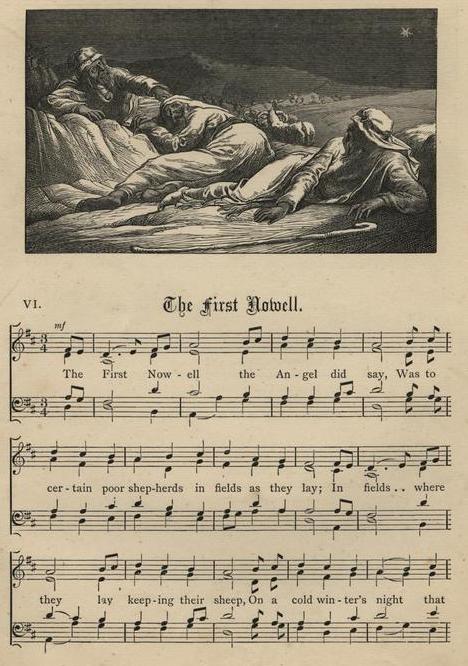
The First Nowell… sort of
The First Nowell (or Noel, as it is commonly written in America) was first published in 1823, though evidence suggests it was sung long before then. The words, however, are slightly different that the ones we sing today. At least one published version of the song had the angels singing “O well” instead of “Noel”.
Joy to the World, Hark the Herald Angels Sing, and Angels From the Realms of Glory… sort of
While each of these songs had words closely relating to those we sing today, their tunes were very different. Many of these songs were poems or lyrics sung to the tune of other, year-round hymns. It wasn’t until the mid-1800s that these songs began getting their own music.
Silent Night… sort of… not really
Unless your hero had connections in a small German town, they would not have heard of this song as it was written in 1816. Even if they did have it somehow, you’d still be singing it in another language.
Songs you could likely have sung with your favorite hero around the pianoforte:
God Rest Ye Merry Gentlemen, O Come All Ye Faithful (Although you were more likely to hear it in it’s original language as Adeste Fideles, English translations existed as early as 1799.), The Twelve Days of Christmas, We Wish You A Merry Christmas
Some songs you wouldn’t hear because they had yet to be written:
Away In A Manger (1885), O Holy Night (1847), Good King Winceslas (1853), It Came Upon a Midnight Clear (1849), O Little Town of Bethlehem (1867), We Three Kings of Orient Are (1857).
What’s your favorite Christmas carol? Do you prefer the older carol-style songs or some of the more modern compositions?
“Those woods are mine and mine alone for hunting.”
“I am afraid, sir, that you are mistaken. Thos woods belong to my family and have been for six hundred years.”
“The deed to the land says otherwise.”
“My sword says more otherwise than the deed.”
“En guard!”
With clashing swords and combat to first blood or death, trial by combat, whether criminal or civil, was not an uncommon way to settle disputes in England in the Middle Ages. In fact, the issue arose in 1818 when someone demanded to settle a dispute in such a manner.
“Are you saying that is still on the books?” One can hear the authorities exclaim. “But we are civilized now. We have a different system.”
Yes, indeed, it was still on the books, though hadn’t been used for hundreds of years.
By the Regency, England’s courts had evolved from the days of trial by ordeal or combat or simple pronouncements from on high. They had become a complex and loosely jointed system of magistrates, justices of the peace, and circuit judges for the assizes.
How the system evolved from the days of Anglo-Saxon rule until the Regency is a complex system on which entire books have been written. This is a brief description of the duties of the men who handled around ninety-five per cent of England’s criminal cases during our time period. It changed again in 1830, and then again in 1971, and we don’t need to fret about those because this is its own era.
Who were justices of the peace and magistrates? They were usually gentlemen who sat in the various offices in London, hearing criminal trials brought to them from various sources. Coroners for murder, for example. Bow Street is the most famous of these offices, and possibly the most famous of the Bow Street magistrates is Sir John Fielding, brother to the eighteenth century author and also a Bow Street magistrate.
Fielding, Sir John, was called the Blind Beak of Bow Street. A “beak” in street cant, was a respected man. Sir John was blinded serving in the royal Navy, but legend has it that he recognized the voices of 3,000 criminals.
Outside of London, we had justices of the peace. These were gentlemen, but not peers. If a peer was a justice of the peace before gaining a peerage, he could keep the post, and peers did not take on the role. JPs performed the same duties of hearing cases as did magistrates. They were simply outside of London. Both sent serious criminal cases up the chain to higher judges.
On a side note here, neither magistrates nor justices of the peace could perform weddings at this time. That fell solely under the jurisdiction of the Church of England.
Outside of London, circuit judges traveled around the country and held trials at the assizes. Assizes occurred twice a year. That meant an innocent man accused of murder could languish in prison for up to six months until the next meeting of the assizes.
Inside London, serious crimes such as murder were heard by the Court of the King’s Bench.
Sadly, corruption, taking of bribes, and other forms of misconduct by judges was not uncommon. In some eras, though I haven’t found much evidence of it during the Regency, judges were removed and even sentenced to death for corrupt practices.
Regardless of these slips into sin, a trial before a judge and jury proved far more effective than trial by combat or ordeal.
Veteran Regency author Regency Regina Scott joins us again to tell us a little more about her writing, as well as her love for Regencies. Regina’s first published book was The Unflappable Miss Fairchild in 1998, with Zebra Regency Romance. Since then she has published continuously, with 19 novels and four novellas to her credit. In the last couple of years, she has turned to writing Regencies with a Christian tone. These have found a home with Love Inspired Historicals. Her fifth Christian Regency, The Rake’s Redemption, is out this month.
1. Last time you were here, you told us about how you fell in love with the Regency time period. What can you tell us about the setting of this new book?
This story is set entirely in London during the Season, but my hero is on the fringes of Society by his own choice, so there’s only a couple balls and most of the action takes place out of doors—driving in the forgotten corners of Hyde Park, meeting in secret at Vauxhall Gardens, dueling on Primrose Hill.
2. Was there any fun fact about the Regency period that you stumbled across in your research for this book that really fired up your imagination? Any little tidbit that prompted a plot point or a cool character moment?
I stumbled across an article written just after the Regency that laid out the specific rules for duels, contrasting them to those of the French. Because my hero, Vaughn Everard, has a reputation as a duelist, knowing some of the rules he could choose to keep or break really helped me write the main dueling scene in the book and keep it in his character. I learned to fence when I was in college, so I really wanted to get that scene right!
3. Does your new book, “The Rake’s Redemption”, continue the story of any of the characters from your last book, “The Captain’s Courtship”? What did you enjoy about writing a linked story? Was there anything about that connection that made writing “The Rake’s Redemption” more difficult?
The Rake’s Redemption is the third book in the Everard Legacy miniseries, starting up shortly after The Captain’s Courtship left off. This book tells the story of how Vaughn Everard finally finds the man responsible for killing his beloved uncle, and his cousin Samantha’s continued attempts to fulfill the requirements of her father’s will.
I love writing linked stories because they give you a bigger canvas on which to lay out an adventure. But they’re also hard, because if you decide later that it would have been better for the hero of book 1 to have done something to set you up for book 3, it’s too late!
4. Tell me a little bit about your hero, Vaughn Everard.
Vaughn is the quintessential warrior poet—literally! He grew up before the Regency began, so he tends to have more of the swashbuckling attitude of the previous era—lace at his cuffs, sword at his side. That puts him in direct contrast with his more elegant, refined peers. And he writes moving, romantic poetry that sets all the ladies’ hearts a-flutter. Can you tell he’s my personal favorite of the three Everard gentlemen?
5. Tell me a little bit about your heroine, Lady Imogene Devary.
Lady Imogene grew up sheltered, the apple of her father’s eye. But she’s noticed her father behaving oddly lately, and she cannot figure out why. The problems seemed to start when a certain poet began calling, demanding a moment with her father. So Lady Imogene sets out to discover what’s going on. Between her own natural charm and her father’s position as the Marquess of Widmore, she’d never had anyone refuse her least request. But then, she’s never met anyone like Vaughn before.
6. What can we look forward to next from you?
Next March, the final book in the Everard Legacy comes out: The Heiress’s Homecoming. That’s Samantha’s story, set 8 years after the other three books, where we how the legacy plays out in her life. She’s only sixteen in the books out this year, so I wanted to give a little time to come into her own.
7. Where else on the web can our readers find you?
Kendrick Lamar’s Super Bowl LIX halftime performance during the game between the Kansas City Chiefs and the Philadelphia Eagles has set the internet—and much of the world—abuzz. Nineteen Minutes by Jodi Picoult is the most banned book in America for challenging the way people see the world. I’m sure those same folks will be coming for Kendrick’s thirteen minutes for challenging the way the world operates.
Less than a week later, scholars, pontificators and fools offered hot takes, deep dives, and debates about every minute of the performance. Those versed in Black scholarship loved it. Others criticized it. And, there were plenty of opinions and outright lies circulating. But here’s what’s undeniable: 133.5 million people watched the halftime show at Caesars Superdome, making it the most-watched in Super Bowl history. According to Roc Nation, Apple Music and the NFL, this number beats those who watched the Fox broadcast of the game which averaged 126 Million viewers. That 7.5 million more tuning into halftime than game time.
Context is King: History of the Halftime Show
Let’s talk about origins. The Super Bowl, the annual championship game of the NFL, has been played since 1967, with college marching bands providing halftime entertainment.
Grambling State University, a HBCU had its marching band perform at Super Bowl II (1968).
In 1972, the first halftime show featuring a Black performer, non-marching band member, was Ella Fitzgerald at Super Bowl VI in Miami where she sang Mack the Knife.
Super Bowl IX (1975) in New Orleans paid tribute to Duke Ellington with Grambling State’s Marching Band and the Mercer Ellington Orchestra.
When was the next Black moment? We have to skip a bunch of years to get to 1991, Super Bowl XXV where the incomparable Whitney Houston delivered a stirring rendition of The Star-Spangled Banner, but she wasn’t the halftime headliner—New Kids on the Block were. In 1993, Michael Jackson, the 1st Black performer to headline the halftime show dazzles the crowds at Super Bowl XXVII (27) and sets the standard for pop stars and the future of football’s biggest event. The King of Pop owned the stage and every moment of his performance. If 100,000 people had actually turned off their TVs like they claimed they did, Michael Jackson would still hold the record, with an audience of 133.4 million viewers.
Other notable performances featuring Black artists across the lengthy history of halftime shows include:
• Super Bowl XXII (22nd, 1988) – Chubby Checker appears with the Rockettes and 88 grand piano players.
• Super Bowl XXIX (29th, 1995) – Patti LaBelle & Teddy Pendergrass were featured along with Tony Bennett.
• Super Bowl XXX (30th, 1996) – Diana Ross dazzled in a red gown and even changed outfits mid-show.
• Super Bowl XXXI (31st, 1997) – A blend of James Brown appearing with ZZ Top and The Blues Brothers Band.
• Super Bowl XXXII (32nd, 1998) – A Motown tribute featured The Temptations, Smokey Robinson, Martha Reeves & The Vandellas, Queen Latifah, and Boyz II Men. Watching those young men of Boyz II Men sing about their mothers hits differently now, especially juxtaposed with Lamar’s solitary silhouette atop the GNX in New Orleans and his dancers, young men gathered under a street lamp.
• Super Bowl XXXIII (33rd, 1999) – Stevie Wonder joins Gloria Estefan and Big Bad Voodoo Daddy.
• Super Bowl XXXIV (34th, 2000) – Toni Braxton is featured.
• Super Bowl XXXV (35th, 2001) – Featured Mary J. Blige and Nelly.
So, let’s be clear: Black performers at the Super Bowl are not new. Hip-hop and rap at the Super Bowl are not new. For those suddenly enraged—why weren’t you bothered during the 39 other years when Black artists weren’t featured or headlined? The selection process has always been based on merit—the most talented for the job, period. Right?
And with DEI (diversity, equity, and inclusion) now the new taboo, let me ask: Why do some get upset when things aren’t diverse—when people who look like them aren’t centered or given an extra slot or quota on stage? Do you want equity and inclusion or not?
Kendrick Lamar is highly qualified. He won the 2018 Pulitzer Prize in Music for his album DAMN. He’s a 27-time Grammy winner, and one cannot deny that his 2024 diss track, Not Like Us, has the world on fire. Please, show me someone with better credentials who’s willing to perform a 13-minute Super Bowl halftime show—for free.
Let’s Dive into the Performance
Lights flash. I see nine squares and glowing X’s and O’s. I wonder—are we about to get Tic-Tac-Toe or something else? In the background, a power bar, formed of stadium lights or drones, begins to load. I know we’re about to witness something special.
More lights flash. The bar is almost at 100%, and I sit on the edge of my seat, expecting a high level of storytelling artistry from Lamar. According to Britannica, art is a visual object or experience consciously created through an expression of skill or imagination—and right now, skill and imagination are exactly what we need.
In a flash, a “Start Here” sign and arrow appear, pointing to the lone figure on the hood of a Buick GNX. Kendrick Lamar, a young Black man, crouches on the car. The image evokes loneliness—it’s dramatic, and I’m locked in as the gleaming black Buick GNX (Grand National Experimental) transforms into a clown car, packed with dancers spilling out. So many exit the vehicle that I later learn the seating had to be removed to fit them all into that tight, cramped space—not unlike bodies crammed into the hulls of ships.
On Instagram, Lamar writes about authenticity: “In the moment of confusion, the best thing you can do is find a GNX. Make you realize the only thing that matters in life is that original paperwork. That TL2 code. 1 of 547.”
What does original paperwork mean when you’re the descendant of chattel slavery? Is it the slave ship’s manifest that documented the theft of ancestors? The bill of sale from massas in the States or Grand Blancs in the Caribbean, depending on where your roots were auctioned off? Or is it the manumission papers, declaring your freedom—bought at a price?
This leads me down another rabbit hole: authenticity—who is American and who is not? In a country that often forgets to be kind to the foreigner (Leviticus 19:33-34), or that it was founded by immigrants—many seeking religious freedom, a fresh economic start, or escape from oppression—this question cuts deep. It’s a scar that never fully heals.
Did you know that, in the past—like I wrote about in Island Queen—people with any tint to their skin have had to carry manumission papers or proof of their free status to avoid being accosted? Many around the nation feel this burden now. We’re still caught in this cycle because we’ve banned the books that teach history and empathy.
Back to Football—America’s Game
I highly recommend reading Moving the Chains: The Civil Rights Protest That Saved the Saints and Transformed New Orleans by Erin Grayson Sapp, which examines the 1965 AFL All-Star Game boycott, where players protested against racial discrimination in New Orleans.
Another must-read is Race and Football in America: The Life and Legacy of George Taliaferro by Dawn Knight, chronicling the journey of George Taliaferro, the first African American drafted by an NFL team, and the challenges he faced.
Red, White, & Blues of Uncle Sam
The visuals cut to Uncle Sam—portrayed by Academy Honorary Award winner Samuel L. Jackson. With a film career grossing over $27 billion worldwide, making him the highest-grossing actor of all time, Jackson embodies this iconic American figure. Some might be wondering, What in the DEI is going on with this Black version of a fictional Americana, but it soon becomes clear: Uncle Sam is here to keep Lamar in line.
Jackson plays Uncle Sam as Uncle Tom. Uncle Tom’s Cabin, Harriet Beecher Stowe’s 1852 abolitionist novel, portrayed White men as morally bankrupt and Black individuals as either complicit in oppression or suffering under it. The book also depicted White women as the moral conscience of a system they benefited from, yet remained angelic through their Christian preaching. The novel ends with the enslaved Tom dying because he refuses to betray two Black women who have escaped. As he dies, he forgives his abusers.
The novel’s humane portrayal of enslaved people and its righteous female characters were said to have contributed to the start of the Civil War. Enraged Southerners banned the book. In the 1940s, Langston Hughes attempted to revive interest in it, but Richard Wright and James Baldwin criticized it, arguing that it promoted the image of an “Uncle Tom”—a Black person subservient to Whites or complicit in oppression.
In Lamar’s performance, Uncle Sam enforces the “party line” of American success. At times, he antagonizes Lamar, telling him, “You’re too loud, too reckless, too ghetto.” He dictates that since Lamar refuse to comply with the rules of the American game, he must be penalized: “Deduct one life.”
The death count is brutal—and so is American history, even without including the countless lives lost under enslavement:
• Fort Pillow Massacre (1864): Confederate soldiers slaughtered surrendering African American Federal troops stationed at Fort Pillow, Tennessee. Between 277 and 295 Union troops were killed.
• Memphis Massacre (1866): A White mob murdered 46 African Americans, most of whom were Union veterans.
• New Orleans Massacre (1866): A White mob killed 35 Black citizens and wounded 100 for peacefully gathering in support of a political meeting.
• Colfax Massacre (1873): A White militia massacred approximately 150 African American militia members who were attempting to surrender in Colfax, Louisiana.
• Wilmington Massacre (1898): A premeditated attack left 60 Black Americans dead as White supremacists sought to eliminate African American participation in government and permanently disenfranchise Black citizens.
• Atlanta Race Riot (1906): White mobs killed at least 12 African Americans and burned over 1,000 homes and businesses in Black neighborhoods.
• Springfield Race Riot (1908): The Illinois state militia was called to quell the chaos as a White mob shot innocent people, burned homes, looted stores, and mutilated and lynched Black residents.
• Chicago Race Riot (1919): The “Red Summer” began when a Black youth was stoned to death for swimming in an area reserved for Whites. Over 13 days of lawlessness, 23 African Americans were killed, 537 were injured, and 1,000 Black families were left homeless.
• Ocoee Massacre (1920): A massacre of Black residents in Ocoee, Florida, left approximately 30 dead.
• Tulsa Race Massacre (1921): Tulsa’s prosperous Black neighborhood of Greenwood, known as Black Wall Street, was destroyed—1,400 homes and businesses burned, nearly 10,000 people left homeless. Vanessa Miller’s The Filling Station is a poignant portrayal of the massacre and the resilient rebuilding that followed.
The sacrifice of Black lives makes Lamar’s imagery of tangled bodies forming the flag raw. It hit me in the pit of my stomach. I live knowing that the sacrifices and body counts will continue to rise, forming trending hashtags: #BreonnaTaylor #AhmaudArbery #TamirRice #TrayvonMartin #GeorgeFloyd
The Movement of Dancers
The visuals of Black dancers dressed in red, white, and blue moving around what is now clearly the game receiver mirror how many of us are on the X button—saying yes to conforming, to getting along, to advancing, to avoiding having our dreams burned up by a jealous or misinformed mob. When the dancers near the circle stage—the reject button—they enter a staircase that leads to a slope, which brings them back to where they started. Is that a metaphor suggesting we are better off right where we began before chasing conformance?
The Most Misunderstood Part: Serena Williams
Serena Williams, who once dated Drake, danced the Crip Walk on stage. Distraught commentators ground their teeth, calling it disrespectful for a forty-year-old mother to be dancing on the figurative grave of her ex.
The caucasity of this is the belief that this exhibition was about a man or a former relationship. Serena Williams is not just some “baby mother.” She was ranked No. 1 in the world in women’s singles by the Women’s Tennis Association (WTA) for 319 weeks—the third-most of all time. Williams has won 73 WTA Tour-level singles titles, including 23 major women’s singles titles. She is the only player to accomplish a career Golden Slam in both singles and doubles.
The Crip Walk is a celebration, notably adopted by her folks from her city of Compton, and it symbolizes the alliance of California street gangs, the Crips— as in Crips vs. Bloods. No, Serena is not part of a gang. But like the dance’s founder, Henry Crip—a Harlem dance legend who lost an arm and a leg in a car accident—she celebrates moving forward and achieving. Williams first did the Crip Walk in 2012 at Wimbledon, eliciting massive backlash for celebrating a huge win—for the girl from Compton.
Seeing her dance freely, hair flowing, I think of the Tignon Laws of New Orleans, which I mentioned in my podcast Consent in the Time When a Black Woman Can Say No, and the long history of policing Black women’s bodies. In Serena, I saw joy and celebration. If I am to think of Drake at all—a man who has used Serena’s name in diss songs—I see freedom from a toxic relationship. That’s cathartic.
Ok, Now the Hotep Or Too Deep to be Real Take
Lamar does say he is a stargazer, so maybe the 16 stars on Uncle Sam’s jacket resemble the Little Dipper. if I squint, I can see it. But the talk online about the design representing the 16 free states—states that prohibited slavery between 1850 and 1858—seems like a stretch. These arbitrary dates are supposedly tied to U.S. naval activities interrupting the slave trade.
I’m not buying this. The U.S. Navy’s role against stopping transport began in 1820 when warships deployed off West Africa tried to catch American slave ships, but enforcement was sporadic until the Navy deployed a permanent African Squadron in 1842. Last time I checked, 1850 and 1842 are different years. A rounding error won’t make them the same.
By 1858, there were 32 states in the Union, including Minnesota, which was admitted on May 11, 1858. California was the 31st state, admitted on September 9, 1850. If I count the list of free states—states that prohibited slavery—I get 17:
1. Pennsylvania – December 12, 1787
2. New Jersey – December 18, 1787
3. Connecticut – January 9, 1788
4. Massachusetts – February 6, 1788
5. New Hampshire – June 21, 1788
6. New York – July 26, 1788
7. Rhode Island – May 29, 1790
8. Vermont – March 4, 1791
9. Ohio – March 1, 1803
10. Indiana – December 11, 1816
11. Illinois – December 3, 1818
12. Maine – March 15, 1820
13. Michigan – January 26, 1837
14. Iowa – December 28, 1846
15. Wisconsin – May 29, 1848
16. California – September 9, 1850
17. Minnesota – May 11, 1858
So the math and the facts aren’t jiving. Kendrick Lamar is very precise in his lyrics. An arbitrary number or pattern doesn’t seem to be his M.O. I could stretch and say he mentions losing 16 friends in his song “wacced out murals,” but then I’m just spitballing.
Not everything has a direct meaning, but that’s the beauty of art—it can mean many different things to different people. Kendrick Lamar and his performance is art and it should be applauded for making us all stop and think.
Ending the American Game
As the last notes of “Not Like Us” finishes, Lamar and company launch into “TV Off.” When he finishes the rap, he holds up a virtual remote, turns it off, and forces the stage to go dark. In lights, we see the sign: Game Over. Does he mean the American game is over because we refuse to learn from the past or that he’s stop playing the game? Lights out—Is that symbolic of a Revolution being televised until it’s not? Is the American Game going to stop feeding on Black life, Black culture, and Black breath? What happens if every American, turns off the TV, the cellphone, social media, etc. and stops playing the game?
America is founded with the God-given right to have differences of opinions. Of being able to choose your path, to dream the biggest dreams, and to make them happen—on or off the field. Whether we play the game or not, movement, not standing still, is how we inch forward toward the goal posts. It’s how we will awaken and form a more perfect union.
Images are screenshots of ROC Nation and Apple Music feeds.
This is a public episode. If you’d like to discuss this with other subscribers or get access to bonus episodes, visit vanessariley.substack.com/subscribe
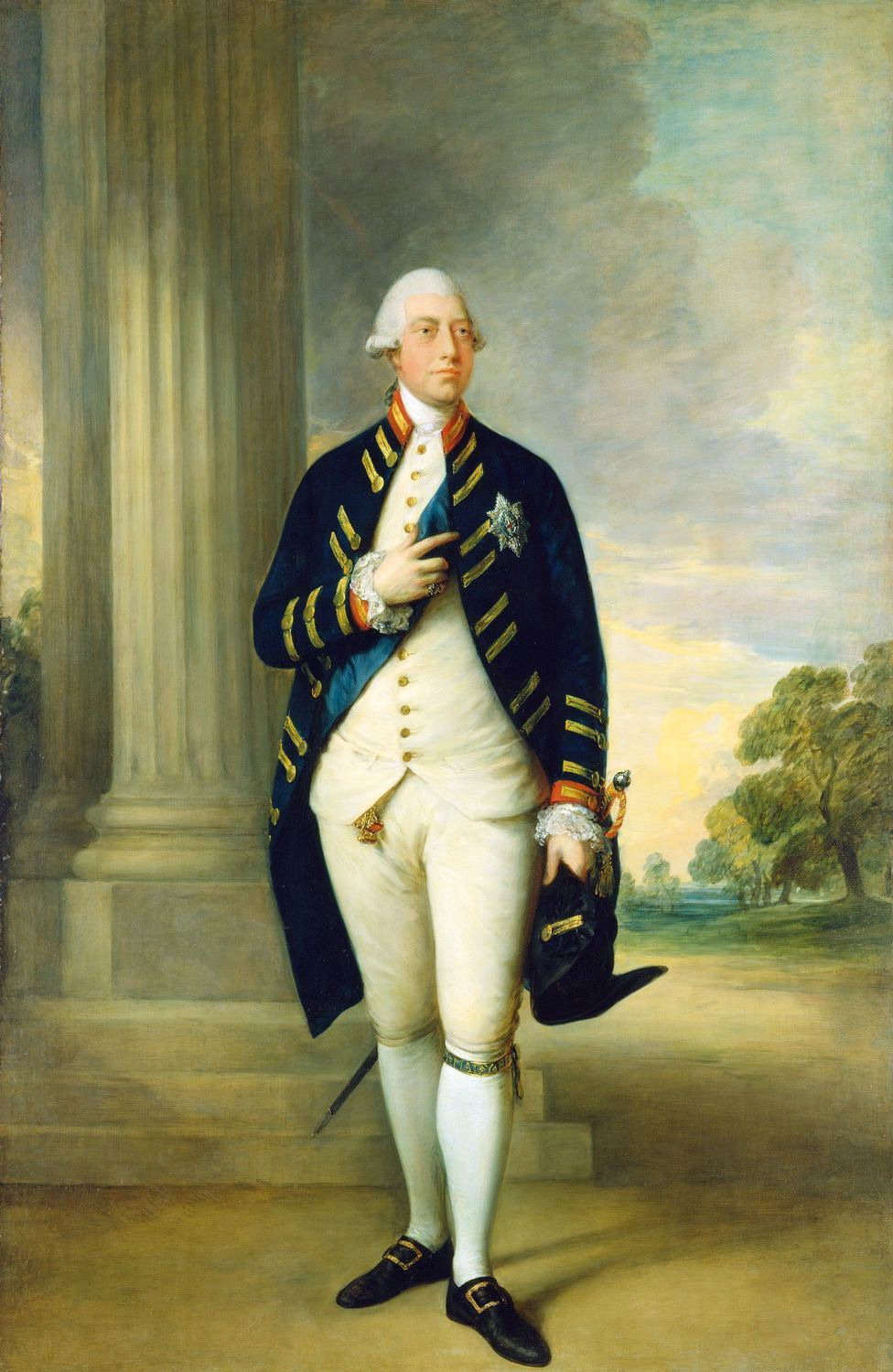
King George III, by Thomas Gainsborough, via Wikimedia Commons
Any Regency aficionado knows that many of our stories are set in the years 1811-1820 when George IV, Prince of Wales was made the Prince Regent. In the Regency Act of 1811 Parliament determined that King George III was unfit to rule. But what do we know of King George III, what is the legacy he left behind during the longest reign of a king up to that point in history?
Personally, he married Charlotte of Mechlenberg-Streltitz and bore fifteen children. It says much about the time that, though his popularity waned over his reign,England’s populace was always proud of him for being faithful to his wife of 59 years!
Source: Wikicommons – Queen Charlotte
Side note: Queen Charlotte is noted to have African ancestry, from Margarita de Castro e Souza, a 15th-century Portuguese noblewoman part of the black branch of the Portuguese Royal House. English Royal painter captured her appearance without softening her features which was called mulatto in nature.
His two eldest sons, George IV (later Prince Regent) and William IV left him constantly faced with their excessive extravagance, dissolute lifestyles and profligate ways. Both of those sons eventually wore the crown, but died without surviving legitimate children.
That began the reign of Queen Victoria, the last monarch of the House of Hanover.
King George III in battle, painted by William Beechey, via Wikimedia Commons
As king, war was the one constant of King George III’s reign. He oversaw the defeat of France in the Seven Year’s War, and was subsequently nicknamed “The King Who Lost America” from the constant battle with the Colonies’ War of Independence. But with the defeat of France in the Napoleonic War,Britain emerged the world’s leading power, though King George III was not in power when it ended.
In Parliament, bad choices in the men he kept around him, and detesting those he had no choice in appointing, made government stability rare and created a volatile atmosphere with his Prime Ministers and in the House of Commons.
But he was also the first British Monarch to study science, chemistry, physics, astronomy and mathematics. He learned French and Latin, geography, commerce, agriculture and constitutional law. And despite the loss of the Americas, there was great expansion of the empire and trade. The population almost doubled and there were great strides in agricultural methods and advances in technology. The tide of moral and religious improvement which began in the days of John Wesley, kept the popularity of a King whose religious education was wholly Anglican.
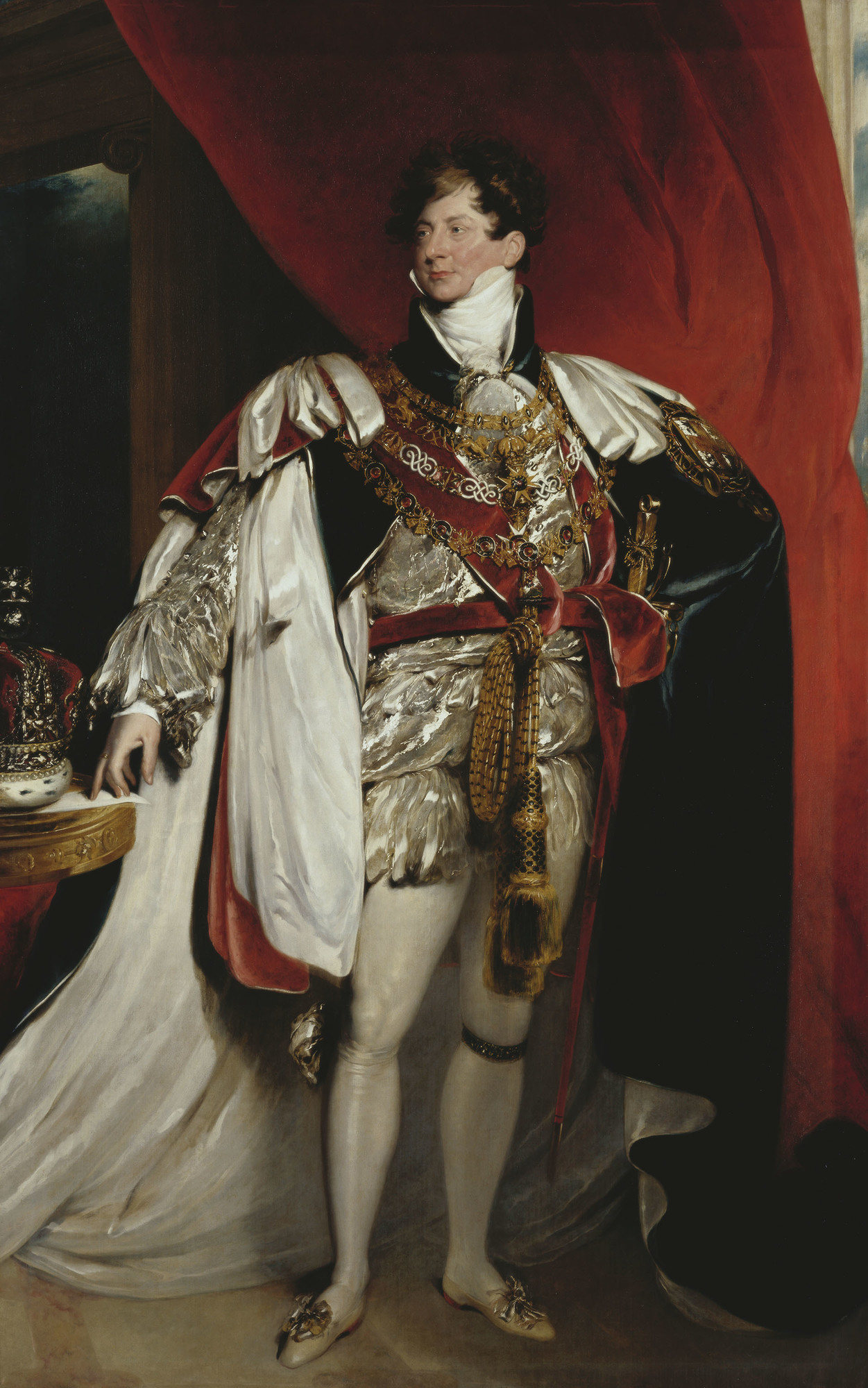
The Prince Regent, Later King George IV, by Thomas Lawrence, via Wikimedia Commons
Unfortunately, he was far from well during the last twenty years of his life. He had three different bouts with mental illness, but in October 1810 he had a major mental breakdown; even to the point of being restrained in a straight jacked and tied into chairs. He was renamed “The Mad King” and he spent the last years of his life completely blind and deaf but lovingly cared for by his wife and doctors.
It is sad to think that the people finally saw him as an object of sympathy once George IV, was made the Prince Regent. Britain’s people watched and compared him to his son as the Prince Regent squandered the already low coffers of England and kept the dissolute lifestyle his father had hated.
For the women who burn it all down, find beauty in ashes.
For the dreamers left behind—keep sailing.”
That is the dedication of Fire Sword and Sea. Four lines that came to me as a battle cry. It’s a reminder that womanhood, especially when tied to leadership, has never been a straight line. It bends, curves, breaks, and rebuilds. It demands courage. It requires clarity. And sometimes, it lusts for fire.
Recently, a friend—someone who does not read much historical fiction—got an early look at Fire Sword and Sea. She’s a reader of self-help, of business strategy, of the occasional thriller you can sneak into her hands. But she said something that stopped me cold:
“Vanessa, you wrote a book about leadership—about women’s leadership.”
At first, I blinked. That wasn’t the answer I was expecting. Yes, my heroine Jacquotte Delahaye is a pirate captain. And yes, pirate captains are leaders by definition. But what my friend saw was something deeper—something I wasn’t consciously aiming for but had apparently woven into every scene, every strike of a sword.
On a pirate ship in the 1600s, leadership wasn’t inherited; it was earned. Pirate vessels operated like meritocracies—any race, any nationality could join, as long as they could pull their weight. Jacquotte rises the only way a woman in that era could: in disguise. Hidden behind lies, she relies on her skill with a rapier, her mastery of the sea, her stamina and grit, and her ability to steer a stolen ship through storms both literal and moral.
Pirates didn’t buy their ships. They took them. And Jacquotte climbs the ladder of command one impossible task at a time.
Through Fire Sword and Sea, we see her rise, her missteps, her victories, her bruises—physical and spiritual. And that, my friend said, is leadership.
But leadership—especially women’s leadership—is a complicated beast.
We often talk about the women who lead in boardrooms, in startups, in medicine, in politics. But historically—and even now—women occupy the caregiver role by default. According to the report released in March by US Healthcare Workforce, 87 percent of nurses are women. The Bureau of Labor Statistics says 80 percent of healthcare workers are women. We are the hospice nurses, the physician assistants, the physical therapists. The ones tending to the young, the old, the fading, the forgotten. And in the 1600s, this was even more pronounced. Before physicians, there were women who gathered herbs, mixed tinctures, whispered prayers, held hands, and ushered people into life and into death and sometimes back again.
To lead, sometimes that caregiving must be set aside. And that choice weighs heavy on nurturers.
Then there is modernity:
How does being a mother affect leadership?
How does being a wife?
How does being the one expected to build the home, nurture the family, care for the elders and in-laws?
I remember climbing the corporate ladder and watching women I admired—women who mentored me—delay motherhood until the last biologically viable second. One of my favorite bosses, a brilliant Irish PhD in physics, once had suits tailored specifically to hide her pregnancy. Because at that time, maternity leave and career advancement could not coexist in the same equation.
This is the landscape women navigate. A landscape Jacquotte would have known in a different form, in a different century—but it’s still hauntingly familiar.
My friend, though, wanted to talk about the dedication.
For the women who do right.
For the women who do wrong for the right reasons.
Because in leadership, there is always a moment—a crossroads—when doing the right thing may mean becoming complicit in something that isn’t right. Sometimes survival demands choices you would never make in a perfect world.
We see the consequences of hubris and hard choices in our real world today. Not to get too political, but right now there is a crisis in the Caribbean that breaks my heart. U.S. forces have fired on fishing vessels, claiming they carried drugs. But no proof has been given. Witness accounts suggest at least one boat was attacked without cause, leaving two people clinging for life. It seems a second strike was orders to kill defenseless victims.
If drugs were aboard, they now sit at the bottom of the sea—destroyed by the same guns that struck the fishermen. This needless killing violates the Geneva Convention, the rules of war and basic humanity.
And now investigations must happen to see how leadership failed and who was complicit in illegal orders. It is a horrible situation when the people in all levels of the chain of command fail. It’s horrid, that those below followed orders that were illegal. Leadership—good or bad—always has accomplices.
And that is part of the burden.
In Fire Sword and Sea, Jacquotte and her crew face their own moral storms. In the 1600s, the “currency” of the seas was not just gold or silver. It was people. African people. A horrid truth I confronted in my research was located in merchant records.
I saw 17 guinea for a pewter bowl.
At first, I thought they meant the coin minted for King Charles II with gold from the country Guinea. But the coin of popularity in the Caribbean. The Spanish silver pieces of eight were. It was upon further digging that these records were referring to people. Everyone from Africa are commonly called Guinea in the 1600s.
So a pewter vessel was valued at seventeen Guinea. Seventeen human lives.
Imagine a world where a pewter bowl was worth more than a child.
So yes—Fire Sword and Sea has action and saga and mystery. But beneath the adventure, it wrestles with leadership, complicity, survival, and the cost of chasing freedom in a world built on stolen bodies.
This book asks questions:
What does it take to lead?
What is the price of doing the right thing?
What happens when you must choose between your principles and your people?
And how do women—across eras—navigate these impossible intersections of duty, ambition, and care?
I cannot wait to have deeper conversations with you about these choices and about leadership.
And so I return to Fire Sword and Sea’s dedication:
For the women who do right.
For the women who do wrong for the right reasons.
For the women who burn it all down, find beauty in ashes.
For the dreamers left behind—keep sailing.”
Books to get us diving deeper into leadership are:
A reflective nonfiction exploration of feminism, aging, ambition, and the fight for autonomy across a lifetime.
Take Care of Them Like My Own — Dr. Ala Stanford: A powerful memoir of a Black woman surgeon who turned grief, racism, and systemic neglect into a movement that vaccinated and cared for thousands during COVID‑19. Soror Ala is running for congress to lead the 3rd congressional district of Philadelphia.
A bold, haunting retelling that gives Medusa her voice back, revealing the girl behind the myth and exploring power, wrath, injustice, and the cost of becoming the monster the world insists you are.
A sweeping tale of ambition, generational power, and the women who shape empires from the shadows, exploring the sacrifices, strategies, and emotional costs of building—and defending—a legacy.
We are six weeks away from the release of course Fire Sword and Sea on January 13th, 2026. Caribbean women pirates—Black women pirates join French and Indigenous women to sail the seas. Review this novel in Edelweiss and NetGalley. Vote for it on Goodreads. Help me get folks talking about this novel.
Consider purchasing Fire Sword and Sea from Baldwin and Company or one of my partners in the fight, bookstore’s large and small who are in this with me.
Come on my readers. Let’s get everyone excited for truth.
Show notes include a list of the books mentioned in this broadcast.
You can find my notes on Substack or on my website, VanessaRiley.com under the podcast link in the About tab.
Don’t let this be a one-time thing—like, share, and subscribe to join the growing family at Write of Passage. Welcome aboard this ship. I heart you.
Thank you for listening. Hopefully, you’ll come again. This is Vanessa Riley.
This is a public episode. If you’d like to discuss this with other subscribers or get access to bonus episodes, visit vanessariley.substack.com/subscribe
Imagine you were transported back to Regency England. What would you want to be? A commoner? Peerage? Royalty? Why?
Susan Karsten:
I would want to be in the merchant class. I do believe the women of this class had less societal strictures and could also sometimes help in the family business. Of course, let my fantasy be that of a successful merchant! 🙂
Ruth Axtell:
I would want to be what I am today in my own era: a romance writer. I’ve been researching the popular novels of the Regency, and it seems that women authors were quite numerous and prolific. The “Minerva novels” were gobbled up by women readers. They specialized in inexpensive romances and gothic novels, which reader could purchase or take out from “circulating” libraries. Mary Russel Mitford and Fanny Burney were two popular authors who made their living writing romantic novels.
Kristi Ann Hunter:
I’m gonna have to go with the peerage, or at least gentry, on this one, for several reason. One, I’m lazy. The idea that someone else would cook my meals and do my laundry has a certain appeal, I must confess. But also, with a higher rank you had the power, time, and money to change things. I would like to have the influence and ability to run a charity or work with the underprivileged. The glitzy parties wouldn’t be bad either.
Kristy Cambron:
I am not sure I would have been a proper member of the peerage (or royalty, for that matter) in Regency England. I find too much pleasure in the vocation of writing, I enjoy the modern comforts of jeans and coffee shops, and I value the rights women have to cote and pursue our dreams in modern society. I also wouldn’t know the first thing about having a service staff attend to my every whim, so I’d have been a poor member of the aristocracy. I’d rather have been a commoner with some means (so I wouldn’t have to stress about where the next meal is coming from), perhaps a friend that was invited into Jane Austen’s parlor from time to time, so we could write our next novel together? I know one thing for sure – I’d adore the clothes more than anything!
Laurie Alice Eakes:
Given the choice, I’d like to be a peeress in my own right like Diana in the Malloren series by Jo Beverley. It was rare and it did happen. The woman had lots of freedom and power other women did not enjoy, even after they married.
Vanessa Riley:
I’d have to be peerage or have enough rank and wealth to assure my family’s position and a suitable match for my daughter. A house in the country and a townhouse in the city, large enough to host a ball.
Naomi Rawlings:
I’d prefer to be a commoner. It’s a hard choice to make, because when I think of peerage, they had such a posh life full of luxuries, beautiful clothes, and the best that money could afford them. But so very little of their wealth was earned. Most of it was handed down generation to generation. Plus the upper class wielded so much power on the back of regular, every day people. I couldn’t live with the guilt of spending a year’s salary on a dress. So I pick commoner. Boring and ordinary, yes. Harder style of living, yes. But they were still the backbone of the country.
Voting and distribution of representation by elected officials is a vital and fascinating topic today as it was during the Regency.
We can now watch legislative sessions live-streamed, or follow issues of interest via the internet, but the doings of the government during the Regency were communicated by way of a journal that was sold by a publisher. In 1806 Thomas Hansard began producing reports of parliamentary debates in a journal published by William Cobbett called Parliamentary Debates. Hansard bought out Cobbett in 1811 and continued to publish the debates. This constituted a watchdog system of sorts.
The set-up of the voting system was ripe for reform. In the early 19th century there were two types of constituency, country areas and towns or boroughs. In the countryside only the landowners could vote. In boroughs the level of enfranchisement varied but was usually limited. The constituencies had not been changed for centuries and no longer reflected the distribution of the population. Industrial towns like Birmingham and Manchester did not have MPs of their own. On the other hand some settlements had died out but they were still represented in parliament! In ‘rotten’ or ‘pocket’ boroughs there might be only one or two voters! And we think red-lining is bad!
The early 19th century saw increasing demand for reforms. Most people wanted constituencies distributed more fairly and they also wanted enfranchisement extended, but Wellington’s party, the Tories, resisted.
The Whigs formed a government in 1830 and tried to introduce reform. The House of Commons eventually voted for a reform bill but the House of Lords rejected it. King William IV warned that he would create more peers, who favored the bill, unless the Lords agreed to accept it. Eventually the House of Lords backed down and passed the Great Reform Bill. It received the royal assent on June 7, 1832.
The franchise to vote was only extended slightly but more importantly the new industrial towns were now represented in parliament. Before 1832 Britain was ruled by an oligarchy of landowners. After 1832 the urban middle class had an increasing say.



 Scrape the chocolate to powder, and put an ounce to each pound of sugar; moisten the paste with clear water, work it as above, only take care to use all the paste prepared, as if it be put on the fire a second time, it greases, and the drop is not of the proper thickness.


 The First Nowell… sort of






 Vanessa Riley: